
Introduction
The United States Tax Court exists to give taxpayers and business owners a fair forum to challenge IRS determinations. Unlike most courts, it allows you to dispute a tax deficiency before paying. That unique feature makes it critical for those facing large assessments, audits, or IRS collection efforts.
This article explains how the Tax Court works, how to file a petition, what to expect at a trial session, and how it compares to district courts and the Court of Federal Claims. You’ll also find strategic tips to navigate disputes and make the process work in your favor.
What Is the United States Tax Court?
The Tax Court began in 1924 as the United States Board of Tax Appeals under the Revenue Act of 1924. Congress restructured it in 1969 as today’s Tax Court, an Article I judicial forum independent of the IRS.
Its headquarters are in Washington, D.C., but the Court has national jurisdiction and holds trial sessions in designated cities across the country. This ensures taxpayers everywhere can access the Court without traveling to Washington.
Key features:
- Independent from the IRS and Treasury.
- Nineteen judges appointed by the President for 15-year terms.
- A Chief Judge oversees administration and assigns cases.
- Senior judges may continue part-time service after retirement.
- Special trial judges handle smaller or less complex matters.
- Cases are heard by one judge; there is no jury.
The Court’s mission is to ensure taxpayers are assessed only what they actually owe under the law.
Jurisdiction: What the Tax Court Hears
The Tax Court’s authority is limited by statute. Common case types include:
- Deficiency cases – after the IRS issues a statutory notice of deficiency (the “90-day letter”), taxpayers may file a petition to contest income, estate, or gift tax deficiencies.
- Collection Due Process appeals – challenges to certain collection actions like liens or levies, after exhausting administrative appeals.
- Innocent spouse relief – disputes where one spouse seeks relief from joint liability.
- Worker classification – disputes over whether workers are employees or contractors.
- Transferee liability – when the IRS claims a third party is liable for another person’s tax debt.
- Other specialized matters – such as declaratory judgments on retirement plans or tax-exempt status.
Importantly, the Tax Court does not hear refund suits. Those belong in District Court or the Court of Federal Claims, where you must pay first and then sue.
Filing a Tax Court Petition
You cannot go straight to Tax Court; you must first receive an IRS notice. The most common trigger is the Notice of Deficiency.
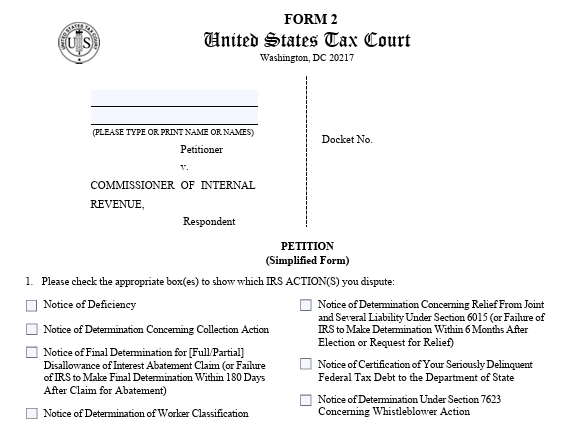
Steps to file:
- Act quickly – You have 90 days (or 150 days if abroad) from the notice date to file your petition. Missing this deadline forfeits your right to appeal to Tax Court.
- Prepare the petition – State your information, tax years at issue, and why you disagree with the IRS. Attach the IRS notice.
- Pay the fee – A $60 fee is required, payable by check, credit card, or money order. Fee waivers are available in cases of hardship.
- File properly – Use the Court’s electronic DAWSON system or mail your petition to the Court’s Washington office. If mailing, use certified mail for proof.
- Request a trial location – Choose from the Court’s list of designated cities closest to you.
- IRS response – The IRS Chief Counsel’s office will file an answer, setting the stage for your case.
Filing a petition stops IRS collection on the disputed amount while the case is pending, though interest continues to accrue.

Small Tax Cases (S Cases)
If the amount in dispute is $50,000 or less for any year, you can elect small tax case status.
Advantages:
- Informal procedure with simplified rules.
- Faster trial and resolution.
- Often heard by a special trial judge.
Limitations:
- Decisions are final and cannot be appealed.
- Opinions do not create binding precedent.
For many individuals and small businesses, S cases are practical.
Pre-Trial Process
Once your case is docketed, several things happen before trial:
- Stipulations – Both sides exchange documents and agree on facts not in dispute.
- Discovery – Requests for records or testimony may occur, though less formally than in other courts.
- Settlement discussions – Many cases are referred back to IRS Appeals for potential resolution. In fact, most Tax Court cases are settled before trial.
- Calendar call – Cases are scheduled in batches for a trial session in your chosen city. The judge will call your case, and you must appear.
Trial in United State’s Tax Court
If settlement fails, your case proceeds to trial. Here’s what to expect:
- One judge presides; there is no jury.
- Trials are open to the public and part of the official record.
- The taxpayer presents first, offering evidence, documents, and testimony.
- IRS counsel cross-examines, then presents their case.
- Both sides may submit written briefs after trial.
The judge’s opinion is later issued in writing, followed by the official tax court decision. This determines whether you owe additional taxes, penalties, or whether the deficiency is reduced or eliminated.
Appeals and Higher Courts
If you lose a regular Tax Court case, you may appeal to your regional Court of Appeals within 90 days. The IRS, through the Commissioner, may also appeal.
Rarely, cases go to the Supreme Court, though very few tax controversies reach that level.
By contrast, small tax case decisions are final – no appeal is allowed.
Tax Court vs. District Court vs. Court of Federal Claims
Taxpayers sometimes face a choice of forum. Here’s a comparison:
- Tax Court – file before paying; specialized judges; no jury; national access; ideal for most taxpayers.
- District Court – must pay and sue for refund; only venue for a jury trial; judges are generalists.
- Court of Federal Claims – also pay first; judges in Washington, D.C.; appeals go to the Federal Circuit.
Strategically, Tax Court is best if you cannot or prefer not to pay upfront. District Court may be useful if you want a jury or circuit precedent favors your case.
Representation in Tax Court
You may represent yourself in Tax Court, but consider professional help:
- Tax attorneys (admitted to the Court’s bar) are the most common.
- Some non-attorneys (CPAs, enrolled agents) can also represent taxpayers if admitted after passing the Court’s exam.
- Low-Income Taxpayer Clinics offer free or low-cost help if you qualify.
- At some trial sessions, pro bono attorneys volunteer to assist unrepresented taxpayers.
The IRS is always represented by its Chief Counsel attorneys, so having skilled representation levels the playing field.
Strategic Advice for Taxpayers and Business Owners
- File on time – Missing the petition deadline is fatal.
- Consider settlement – Many disputes are best resolved before trial.
- Use small tax cases wisely – They are efficient but final.
- Prepare documentation – Good records often determine the outcome of cases.
- Engage Appeals – Even after filing, negotiation is possible.
- Be professional – Judges respect taxpayers who follow procedure and act with candor.
Strategically, Tax Court is not just about winning or losing – it’s about managing risk, time, and potential exposure to penalties.
United States Tax Court: In Summary
The United States Tax Court is a vital safeguard for taxpayers and business owners facing IRS disputes. By allowing you to challenge a deficiency before payment, it ensures that the IRS is not the final word on your taxes.
Understanding how to file a petition, what happens at trial, and when to consider settlement or appeal equips you to navigate this process strategically. Whether through a regular case or the simplified small tax case procedure, the Tax Court exists to make sure you owe only what the law requires – no more, no less.
For many taxpayers, that knowledge alone provides confidence in standing up to the IRS and asserting their rights in court.
How Paladini Law Can Help
Navigating the United States Tax Court is not easy. From filing a timely petition to negotiating with the IRS and presenting evidence at trial, the process can be overwhelming even for the most organized business owners. The IRS will always have its attorneys from the Office of Chief Counsel representing their side. You deserve the same level of experienced, strategic representation.
At Paladini Law, we focus exclusively on tax disputes, tax appeals, and IRS controversy matters. We’ve guided countless taxpayers through audits, deficiency notices, and Tax Court litigation. Whether your goal is to settle before trial or pursue a full hearing before a tax court judge, we’ll give you the strategy, advocacy, and attention to detail you need.
Our approach is straightforward:
- Review and Strategy – We evaluate your IRS notice, deadlines, and the strength of your position.
- Filing and Representation – We handle your petition, filings, and appearances so you never miss a critical step.
- Negotiation and Settlement – We know how to work with IRS Appeals and counsel to seek favorable resolutions.
- Trial Advocacy – If your case goes to court, you’ll have an attorney with years of experience in front of Tax Court judges, making sure your rights are protected.
If you’ve received a Notice of Deficiency, are facing IRS collection actions, or have questions about filing delinquent tax returns, now is the time to act. The Tax Court deadlines are strict, and missing them could cost you your right to challenge the IRS before payment is required.
Contact Paladini Law today to schedule a consultation. Let’s discuss your case, outline your options, and build a plan to protect your business and financial future.